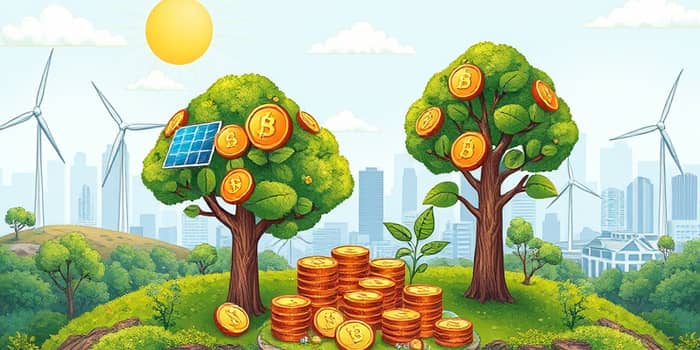
Imagine a future where your income not only grows but does so with purpose and durability.
This is the promise of sustainable investing in 2026, where resilient, long-term income generation becomes a cornerstone of financial empowerment.
By focusing on strategies that integrate environmental, social, and governance (ESG) principles, you can unlock competitive yields while addressing climate risks in a volatile world.
Demographic shifts and rising inequality are reshaping investment landscapes.
These trends fuel demand for innovative investments in resilient systems, from healthcare to education.
Advisors must now expand their planning approaches to ensure income strategies withstand economic pressures.
Key actions include:
This holistic view empowers individuals to build wealth that lasts.
Artificial intelligence is revolutionizing how we approach sustainable investing.
It embeds ESG insights into decision-making, enhancing transparency and driving long-term value creation.
Data-driven technologies, such as AI climate models, boost yields in sectors like agriculture.
For instance, drought-resistant crops can see yield increases up to 30% with predictive analytics.
AI also automates tasks for financial advisors, improving client experiences and supporting growth.
Benefits include:
Embracing these tools can transform how you grow your earnings.
Climate change is no longer just a risk—it's a lucrative opportunity.
Decarbonization efforts are shifting from pledges to action, with markets aligning to frameworks like Net Zero.
Investing in climate and nature solutions offers durable returns amid economic shifts.
The adaptation market is booming, projected to grow from $1 trillion in 2025 to $4 trillion by 2050.
Key sectors include infrastructure, agriculture, and water management.
However, challenges like uncertain cash flows require strategic planning.
To capitalize, consider:
This approach turns environmental stewardship into a powerful income stream.
Selecting the right assets is crucial for sustainable income growth.
Green bonds, for example, have grown from €30 billion a decade ago to €1.9 trillion, funding renewables and low-carbon transport.
Similarly, adaptation bonds saw $572 billion in issuance in 2024, highlighting their rising importance.
Fixed income strategies favor investment-grade credit for yield pickup, while infrastructure assets provide diversification.
The table below summarizes key sustainable investment options:
These vehicles offer cash-flow-generative assets with impact, ensuring your income is both resilient and responsible.
Additional options include sustainable debt in Asia-Pacific, where record growth is expected.
Notable examples are Ecuador's $1.6 billion debt-for-nature swap and Goldman Sachs' $500 million biodiversity fund.
By diversifying into these areas, you can build a portfolio that thrives.
Regulatory shifts are making sustainability a core resilience strategy.
In 2026, pragmatism prevails, with sharper definitions for transition finance under frameworks like SFDR.
Asia-Pacific leads in energy transition and sustainable debt, while Europe focuses on sovereignty themes.
Challenges include fragmented markets and data gaps, but solutions are emerging through standards and scenario analysis.
For real estate, regulatory pressures are driving green premiums and resilience funding.
Key trends to watch:
Staying informed helps you navigate these changes effectively.
While opportunities abound, risks like geopolitical shifts and AI cyber threats must be managed.
Climate physical impacts can disrupt income streams, but inaction costs more in the long run.
For individuals and advisors, growth imperatives include developing marketing plans and succession roadmaps.
Business levers such as circularity and sustainable product design enhance resilience.
To empower your earnings responsibly, consider these steps:
By viewing sustainability as a hedge against volatility, you can unlock growth in underserved markets.
This mindset shift—from gambler to owner of yield-generating assets—empowers you to thrive.
Ultimately, sustainable investing in 2026 is about more than profits; it's about building a legacy of positive impact and financial security.
Embrace these strategies to grow your income responsibly and make a difference in the world.
References