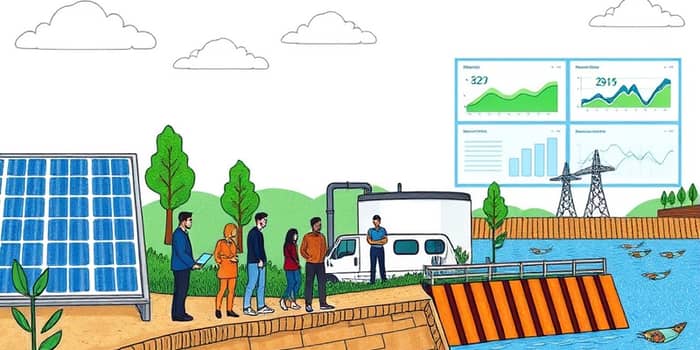
The world stands at a crossroads where rising temperatures and extreme weather events threaten communities, ecosystems, and economies. Yet within this looming crisis lies an unprecedented potential for investors, innovators, and policymakers to transform vulnerability into opportunity. By harnessing the power of resilience and adaptation, stakeholders can not only protect assets but also unlock new markets and drive sustainable growth. This article illuminates the data, identifies the trends, and offers practical guidance to navigate the evolving landscape of climate adaptation and resilience investment.
Climate-related disasters have already inflicted more than $3.6 trillion in damages globally since 2000, underscoring the critical need for proactive measures. Research indicates that, without adaptation measures, global GDP could shrink by up to 22% by the end of this century. Recent events, such as the January 2025 wildfires in the greater Los Angeles area, have highlighted the staggering economic toll and galvanized widespread calls for action.
At the same time, failure to invest carries hidden costs: disrupted supply chains, lost productivity, and increased insurance premiums. Bridging the financing gap is essential to safeguard communities and deliver tangible returns for investors willing to pioneer solutions.
The climate adaptation and resilience sector is not a distant vision—it is already a multi-trillion-dollar market. Today, the total opportunity is approximately $2 trillion, with projections estimating growth to $9 trillion by 2050. This trajectory is driven by rising demand for infrastructure upgrades, risk analytics, and resilient technologies.
In the near term, developed economies alone could require between $0.5 trillion and $1.3 trillion annually by 2030. Meanwhile, the UN Adaptation Gap Report highlights that Global South countries will need $215 billion to $387 billion each year during the same period. Alternative estimates suggest that technologies supporting climate resilience could tap into addressable markets worth $600 billion to $1 trillion by 2030.
These figures capture a powerful truth: investing in resilience is not just a moral imperative but a projected to grow to $9 trillion financial opportunity for those who move early and decisively.
Despite the clear case for adaptation, private capital has traditionally skewed toward decarbonization efforts. To date, over $650 billion has been allocated to decarbonization and broader sustainability funds, compared to less than $8 billion dedicated explicitly to resilience. This imbalance signals a ripe opening for investors to differentiate their portfolios and drive meaningful impact.
The momentum in 2025 is building, albeit from a slower start. Equity investment in climate risk assessment reached $324 million in 2024, marking the highest funding year to date. Early-stage deals have steadily increased since 2022, indicating growing confidence in the commercial viability of adaptation technologies.
As regulatory frameworks tighten and transition planning becomes mandatory, the flow of capital toward climate-aligned assets is expected to accelerate. Savvy investors will position themselves ahead of policy shifts to capture outsized returns.
The adaptation landscape encompasses a diverse range of sectors, each offering distinct pathways to growth and innovation. From data-driven analytics to engineered defense systems, opportunities abound for specialized service providers and technology developers.
Beyond these core areas, emerging technologies are reshaping the energy and data landscapes:
global electricity demand is driving massive investment in renewables, nuclear, and grid upgrades. The IEA forecasts that renewable capacity will expand by roughly 4,600 GW between 2025 and 2030, doubling the deployment of the previous half-decade.
Meanwhile, green hydrogen and sustainable aviation fuel projects are gaining traction. The green hydrogen market is projected to surge from $1.5 billion in 2025 to over $125 billion by 2035, while demand for sustainable aviation fuel could exceed production capacity by more than 23 million metric tons by 2035.
Data center investments for AI applications reached $300 billion in 2024, with green bond issuances targeting sustainable infrastructure poised to cross $7 billion in 2025. Yet, grid investments continue to lag, highlighting another clear target for capital deployment.
Financial evidence confirms that adaptation strategies yield strong returns. Over 80% of companies investing in decarbonization report benefits that exceed 10% of revenue, while adaptation efforts deliver immediate, measurable value—averaging a 1% revenue return in the short term.
Nearly half of the organizations that have implemented resilience measures report a return on investment surpassing 10%, demonstrating that risk mitigation can translate directly into enhanced profitability and competitive advantage. By quantifying these gains, businesses can justify further investments and strengthen stakeholder confidence.
This dynamic underscores a transformative truth: proactive adaptation is as much about seizing economic upside as it is about protecting assets.
To capitalize on the rising tide of adaptation investment opportunities, stakeholders should consider the following actions:
By integrating these steps into investment strategies, stakeholders can not only enhance returns but also build enduring resilience against future shocks.
The journey from climate risk to investment opportunity demands vision, ingenuity, and decisive action. Investors who embrace this paradigm shift will not only contribute to safeguarding the planet but will also unlock new sources of growth and value. The race is on to bridge the financing gap and scale solutions that will define the resilience of tomorrow.
Now is the moment to harness capital, catalyze innovation, and align financial objectives with the urgent need to adapt. Together, we can transform vulnerability into strength, risk into reward, and uncertainty into prosperity.
The future belongs to those who see climate adaptation not as a cost, but as a powerful engine for sustainable development and long-term success.
References