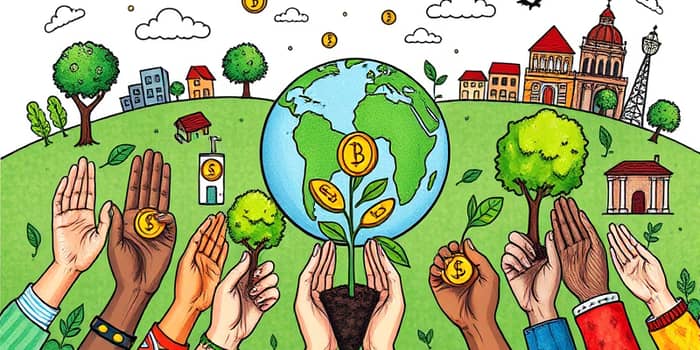
Financial systems have the potential to uplift individuals, strengthen communities, and protect our planet. In an era of profound social and environmental challenges, embracing responsible finance offers a way to channel capital as a force for collective good.
From microloans that empower entrepreneurs to green bonds that restore ecosystems, each financial decision carries weight. This article delves into the core concepts, guiding principles, and real-world applications that make finance as a force for good a tangible reality.
Responsible finance encompasses the delivery of transparent and ethical financial services that balance client well-being with long-term institutional resilience. It builds upon social performance management to ensure that providers act in the best interest of clients, preventing harm and fostering trust.
Key pillars include mission-driven operations that reinvest surpluses for social and environmental benefit, fair treatment through clear pricing and respectful collections, and rigorous client protection standards (covering data privacy, dispute resolution, and over-indebtedness prevention).
By aligning daily operations with global agendas such as the UN Sustainable Development Goals and the Paris Climate Agreement, responsible finance transforms abstract commitments into measurable impact. Institutions that prioritize prevent harm like over-indebtedness can build deeper relationships and enhance long-term viability.
Embedding responsibility into finance requires adherence to robust international frameworks. Leading standards include:
These principles foster accountability through regular reporting, stakeholder engagement, and continuous improvement. They serve as signposts, helping providers embed ethics into credit scoring, product design, and corporate governance.
Responsible finance practices can be tailored to impact individuals, communities, and the planet in distinct yet complementary ways.
At the pocket level, microfinance institutions extend small loans, savings, and insurance to excluded populations. By coupling credit with financial literacy workshops in schools and community centers, they enhance clients’ decision-making and resilience.
At the community and business level, local lending schemes and technical assistance nurture small and medium enterprises. For example, UK providers issued £251 million in responsible loans in 2015, helping thousands of households manage unexpected costs and creating over 30,000 jobs.
At the planetary level, impact investors channel capital into renewable energy, sustainable agriculture, and biodiversity restoration. Carbon-neutral operations and nature-positive financing demonstrate how the financial sector can facilitate a just transition to a low-carbon economy.
Evidence underscores the transformative power of responsible finance. Key achievements include:
Beyond numbers, these initiatives have reduced reputational risk, enhanced resilience to economic shocks, and unlocked new market opportunities. Recent World Bank and IFC-led reforms in Cambodia illustrate how regulatory action can expand credit access while prohibiting abusive practices.
By embracing building financial capability in clients, institutions position communities to thrive amid uncertainty and adapt to evolving challenges.
Despite notable progress, the journey toward universal responsible finance faces obstacles. Gaps remain in coordinating transparent markets, monitoring emerging digital products, and ensuring equitable access across geographies.
Stakeholders must collaborate closely: regulators can enforce tailored insolvency and consumer protection regimes; investors can require social and environmental covenants; providers can adopt stringent codes of conduct and borrower assessment tools; consumers can benefit from ongoing financial education.
Innovations such as employee profit-sharing and multi-stakeholder consultations—seen in Ardian’s models and Cambodia’s policy reforms—highlight the evolving landscape. Continuous vigilance and adaptive governance are vital to respond to new risks and opportunities.
As our world grapples with inequality, climate change, and social fragmentation, responsible finance offers a blueprint for equitable growth. By championing reinvesting profits for community benefit and alignment with global development goals, we can ensure that each financial decision contributes to a sustainable, inclusive future.
Embrace the power of responsible finance today—transform pockets of need into flourishing communities and safeguard the planet for generations to come.
References