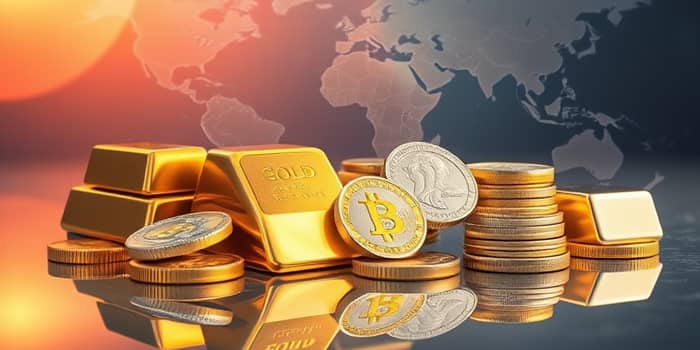
In an era defined by volatility and rapid change, investors and savers alike seek refuge where value endures. Precious metals have long served as that sanctuary, offering both stability and growth amid uncertainty.
As global markets shift and currencies fluctuate, understanding the forces shaping precious metals can empower you to make informed, confident decisions.
The global precious metals market stands at USD 302.79 billion in 2025 and is projected to reach USD 545.57 billion by 2034, growing at a CAGR of 6.77%. Asia Pacific commands the lion’s share at 60% in 2024, while North America is poised for significant gains over the next decade.
Product segmentation highlights gold as the undisputed leader, comprising 83% of market value in 2024, with industrial applications accounting for 46% of demand. The jewelry segment is forecast to be the fastest-growing application driven by emerging middle-class wealth.
Gold entered 2025 at new record highs in all currencies, propelled by inflation concerns and geopolitical tensions. J.P. Morgan Research foresees gold averaging $3,675 per ounce by Q4 2025 and climbing toward $4,000 by mid-2026.
Silver’s industrial demand set a weight record in 2024, and forecasts suggest sustained growth if renewable energy and electronics sectors expand as expected.
Several forces conspire to propel precious metals higher:
Supply chain disruptions—from mining constraints to geopolitical strife—create additional tailwinds. Silver may experience shortages if mining regions face unrest, while platinum supply grows only modestly despite recycling efforts.
Gold: Outperforming nearly every major asset in early 2025, gold benefits from jewelry demand in India and China, technological uses in electronics and medical devices, and sustained buying by central banks.
Silver: Its dual identity as both precious and industrial metal makes silver more volatile than gold. Yet, if solar installations, EV production, and electronics expand as forecasted, industrial demand could drive silver prices significantly higher.
Platinum faces a supply deficit, especially in automotive catalysts and hydrogen energy applications, supporting a projected 29% price rise in 2025.
Palladium contends with oversupply in gasoline-engine catalyst markets, keeping prices under pressure despite stabilization efforts in 2024.
Asia Pacific’s dominance is clear: its market is valued at USD 181.67 billion in 2025 and set to surpass USD 330.07 billion by 2034 at a CAGR of 6.86%. North America’s share is growing as investors seek safe havens and industrial users expand.
Notable developments in May 2025 include Russia’s Krasnoyarsk region seeking cooperation with Belarus on metal recycling, and India aligning import regulations to bolster its precious metals framework.
Navigating the precious metals landscape requires balancing optimism with caution. Geopolitical tensions, inflation pressures, and shifts in central bank policies will continue to influence prices.
To harness the sector’s potential:
By staying informed and proactive, investors can transform uncertainty into an opportunity. Precious metals offer not only a shield against economic storms but also a bridge to future growth as technology and sustainability reshape global demand.
Embrace the stability of metals that have preserved wealth for millennia, and position your portfolio to thrive in the unpredictable landscapes ahead.
References