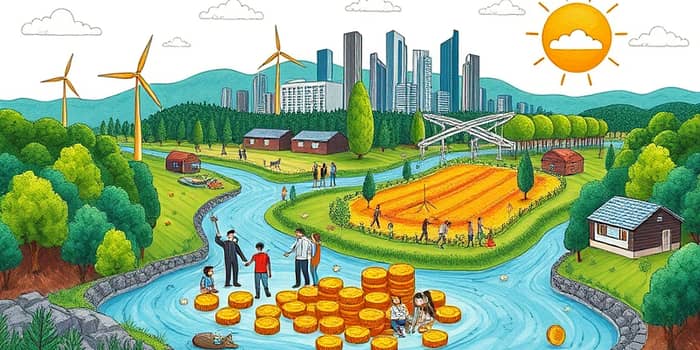
In an era defined by environmental urgency and social inequity, finance holds the power to reshape our world. By realigning capital flows with enduring values, we can spark a transformation that reverberates across economies, societies, and ecosystems.
At its core, sustainable finance involves aligning financial systems and services to advance environmental stewardship, social equity, and economic resilience. The Canadian Expert Panel describes it as capital flows, risk management, and processes that assimilate environmental and social factors for long-term impact. The European Environment Agency further clarifies that this approach integrates environmental, social, and governance considerations into every investment decision.
Within this umbrella, green finance targets environmental objectives such as biodiversity preservation, water protection, pollution prevention, circular economy development, and climate mitigation. Together, sustainable and green finance form the backbone of a future-focused economy.
Achieving true systems change demands an irreversible shift in technologies, value chains, and economic dynamics. Unlike incremental tweaks, this transformation tackles root causes and power structures, ushering in new patterns of interaction and behavior.
Distinguishing genuine systems change from mere optimization is crucial. Improving carbon-fuel efficiency extends the old paradigm, while transformative solutions introduce new values like sustainability at every level.
The sustainable finance market has surged to unprecedented heights. In 2024, global sustainable debt issuance surpassed US$1.6 trillion—an 8% increase from the previous year—while overall sustainable assets under management reached US$3.2 trillion. This growth underscores resilience amid market volatility and signals enduring investor commitment.
Looking ahead, forecasts predict around US$1 trillion in sustainable bond issuance for 2025, suggesting stabilized momentum. However, emerging headwinds such as regulatory complexity and market skepticism may temper explosive growth.
Sovereign, supranational, and agency issuers led the charge in 2024, issuing US$530 billion in sustainable bonds. Multilateral Development Banks committed to ramp up climate financing, pledging US$120 billion annually by 2030 and US$300 billion by 2035.
Corporate issuers in digital infrastructure, utilities, and chemicals also recorded significant growth, fueled by AI-driven demand and ambitious sustainability roadmaps. Meanwhile, private finance for nature skyrocketed elevenfold since 2020, exceeding US$100 billion in 2024, highlighting the recognition of "nature capital" as essential for long-term returns.
Agrifood investment rose over 300% since 2019, reaching US$95 billion annually. Regenerative agriculture, resilient livestock practices, and deforestation-free supply chains demonstrate how capital can address systemic challenges while strengthening portfolios.
Despite robust market expansion, trillions remain unmet for Sustainable Development Goals, infrastructure, and nature-positive transitions. Annual climate finance needs average US$6.3 trillion through 2030, while nature-related investments require up to US$2.7 trillion each year.
Public sector capital plays a pivotal role in financing early-stage experimentation and system redesign. Governments and state investment banks, such as Germany’s KfW, de-risk pioneering projects, build infrastructure, and cultivate enabling environments that attract private participation.
Systems change in one sector unlocks potential in others. Germany’s energy transition, for example, spurred economic equity, resilience, and decentralization. Focusing on food production alone misses opportunities to address energy transportation, environmental impact, and wealth distribution.
Embracing a systemic investing mindset requires broad scale of aspiration for change across energy, food, finance, and governance. By understanding these interdependencies, stakeholders can craft solutions that generate cascading benefits and systemic resilience.
The evolving policy environment influences both issuers and investors. Heightened greenwashing scrutiny, including Canada’s Bill C-59 and EU fund labeling rules, demands greater transparency and rigor. Meanwhile, the EU Taxonomy on Climate Change sets clear criteria for sustainable activities, mobilizing private investment toward green technologies.
Yet challenges persist: social bonds face a scarcity of benchmark projects; transition-labeled and sustainability-linked bonds remain niche; and fund market stagnation highlights the need for ongoing innovation and stakeholder education.
To harness the transformative potential of finance, stakeholders can take concrete actions:
By collaborating across public, private, and civil society sectors, we can design approaches that are scalable, equitable, and resilient.
Systemic change is within reach when finance is wielded as a force for good. By integrating sustainability at every decision point, financing bold prototypes, and redesigning enabling environments, we can unlock pathways to a thriving, regenerative economy. The journey demands courage, collaboration, and relentless innovation—but the returns, measured in ecological health, social well-being, and economic vitality, are immeasurable.
References