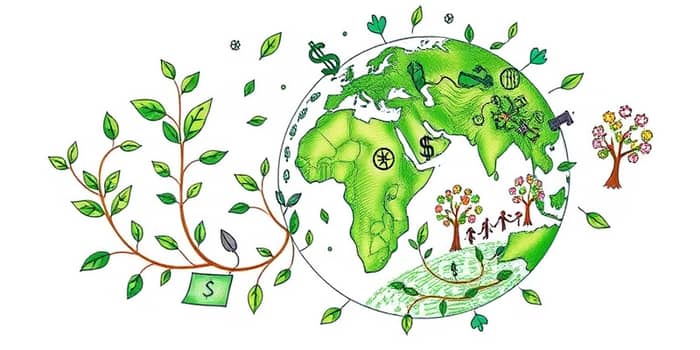
In a world facing unprecedented environmental and social challenges, sustainable finance has emerged as a catalytic force. It channels capital toward projects that protect our planet, strengthen communities, and build resilient economies. By aligning investments with environmental, social, and governance principles, investors and institutions can sow seeds of transformation that echo across sectors and borders.
The sustainable finance market has witnessed remarkable expansion. From under USD 3 trillion a few years ago, it soared to a staggering USD 5.87 trillion in 2024. Forecasts suggest a compound annual growth rate of 19.8% through 2034, signaling robust investor confidence and increased appetite for impact-driven assets.
This surge is not merely quantitative. It reflects a paradigm shift: financial players are embracing metrics beyond short-term returns. They recognize that environmental degradation and social inequity pose material risks to portfolios. Aligning capital with global sustainability goals has become both an ethical imperative and a sound business strategy.
Europe remains a frontrunner, with the United Kingdom commanding roughly 25% market share and generating around USD 585 billion in sustainable finance revenue in 2024. Across the Atlantic, the United States and Canada have ramped up ESG integration, while Asia’s leaders, notably China and Singapore, showcase rapid growth.
China’s green lending sector exemplifies this momentum: outstanding green loans reached RMB 42.39 trillion, a 14.4% increase since early 2025, while green bond issuances exceeded RMB 4.6 trillion. This dynamic expansion in emerging economies underscores global commitment to sustainable development.
Emerging economies are charting impressive advances. The 2025 Global Progress Report highlights 72 countries mobilizing sustainable finance frameworks. Collectively, these markets represent USD 79.5 trillion in banking assets. With 145 new frameworks introduced since 2023, financial institutions are integrating ESG into credit risk assessment and fostering clearer regulatory landscapes.
Despite this progress, financing gaps loom. Emerging markets require an additional USD 4 trillion annually to meet Sustainable Development Goals. Without significant reform, this gap could swell to USD 6.4 trillion by 2030.
International climate finance reached USD 196 billion in 2023, with 78% from public sources. Yet adaptation funding remains underreported at USD 65 billion, while mitigation dominated USD 1,780 billion of global flows. Dual-benefit projects secured USD 58 billion, and agrifood climate finance leapt over 300% since 2019 to USD 95 billion.
Nature-positive investments have soared elevenfold since 2020, surpassing USD 100 billion in 2024. The World Economic Forum estimates a USD 10 trillion annual business value and nearly 400 million jobs by 2030 in nature-positive transitions. Realizing this vision demands up to USD 2.7 trillion yearly.
Technological innovations—from AI-powered ESG analytics to blockchain-based asset tracking—enhance transparency and drive new opportunities. Low-carbon private investments grew 123% in five years, proving sustainability can be a competitive edge rather than a cost center.
Development finance institutions, like the IFC with its record USD 71.7 billion commitment in 2025, and multilateral banks expanding blended finance mechanisms, are vital partners. They bridge public and private capital, de-risking projects and unlocking local potential.
Food systems underscore critical sectoral opportunities: accounting for 10% of global GDP and 40% of jobs, agrifood climate finance now stands at USD 95 billion. Regenerative agriculture, resilient livestock, and circular food models offer high-impact, scalable solutions.
Yet challenges persist. Heightened scrutiny on greenwashing, evolving regulations, and political headwinds demand vigilance. The lack of robust sustainability data on developing-country equities hinders investment flows, underscoring the need for standardized reporting and capacity building.
As stakeholders—from institutional investors to grassroots entrepreneurs—embrace sustainable finance principles, the ripple effect intensifies. Every dollar invested in clean energy, biodiversity, or social impact resonates, fostering healthier ecosystems, resilient communities, and inclusive growth.
Now is the moment to harness this momentum. By championing transparency, innovation, and collaboration, we can accelerate capital toward transformative projects. Together, we can ensure that sustainable finance not only flourishes as a market, but also serves as a beacon of hope, steering our world toward a prosperous, equitable, and resilient future.
References